To the Mom of the Typically Developing Child at the Special Needs Gym

sensory gym
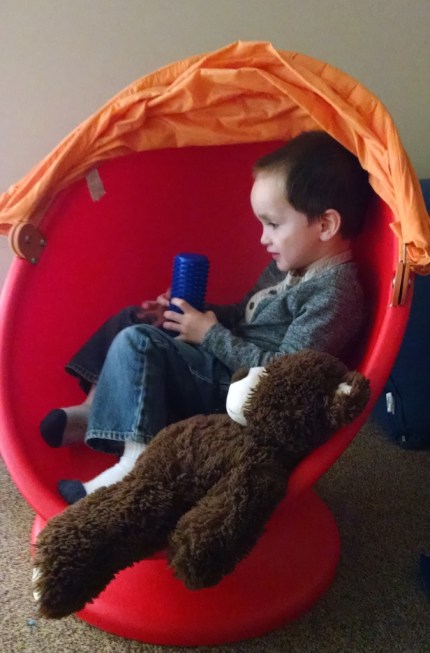
R, enjoying a fidget toy in the spinning egg chair at the special needs sensory gym

I realize that I don’t know your story.  I realize that your child may have a speech delay, or been followed by EI after a premature birth, or beaten a devastating disease.  I don’t presume that she has had a completely typical life.  But I can see, at this point in time, that she is a typically developing toddler.  I have seen you and her almost every single time I take my son to the special needs sensory gym.  She is over a year younger than my son, and is a sweet, curious, and playful little girl.  I see that.  I see that she is adorable.  I do.  I know you wonder why I avoid you and her, why I cringe when she barrells over to us.  I know you are perplexed when I don’t seem appreciative that you have prompted her to greet my son, when you have praised her for offering him a toy or “helping” him with something.  I know you thought it was strange and perhaps a bit rude that I was not eager to bring my son into the rocking boat with her when she requested and you asked us.

Here’s the thing.  I don’t mean to sound unkind, but the truth is, we come to this place to avoid children like your daughter.  There’s nothing wrong with typically developing kids.  It isn’t that I don’t like them, that I don’t like your daughter.  I have two NT kiddos at home myself.  But the special needs gym is a haven for my Autistic son–and I’ll admit–for me.  It’s the one place where we can completely be ourselves.  It’s the one place where my son is not the odd one out.  It is the place where no one bats an eye when a child is happily stimming away, or has a meltdown.  It’s the place where I don’t have to explain anything to anyone.  And it’s the place where I don’t have to see the harsh comparison between him and his typically developing peers.

It’s also one of the few places he can enjoy due to his anxiety in public spaces.  We cannot go to the library.  We cannot go to the mall play spaces.  We cannot join a mommy and me group or take a gymnastics class or visit the Y.  But we can go to the special needs gym, and it is my son’s favorite place in the entire world.  It is also a place where he is generally free from the attentions of other children, which he finds agitating.

So when your daughter runs over to us, staring me in the eye, chattering away, and shoves a toy in my son’s hands, it is all wrong here, in this safe place.  He freezes, waits for her to leave him be.  I cringe, hearing all the words my son can’t say from the mouth of a child half his age.  I see her share attention and play pretend and it just reminds me how different my son is.  It pops my happy bubble, and I feel the worry creep in.  I don’t need my boy to speak or look me in the eye, I don’t need him to play “appropriately.”.  Yet absurdly, it still hurts to see other children doing those things so easily, so naturally, like it’s absolutely nothing.

When your daughter asked my son to join her in the rocking boat, and you repeated the question when he didn’t look or respond, I had to explain.  I had to tell you that he doesn’t speak or understand yet.  But I don’t come here to explain.  I come here because it’s supposed to be the place where explanations are not necessary.

I saw the confirmation on your face.  You had been pretty sure he was different, but now you really knew.  I watched you prompt your daughter to always say “hi” and “bye” to my son after that.  I watched you praise her when she brought him things he didn’t want.  I watched you caution her to give him space when it was clear she overwhelmed him.  Perhaps you were just doing what you would have done with any child.  But a part of me felt we were being used as props to teach your perfect child how to interact with “those” kids.  I resented it.  We don’t need the charity of your child’s attention.

After that I started to avoid you.  I know you noticed, but I’m not strong enough yet.  There are other special needs moms that can interact with moms of typical kids and it doesn’t affect them.  They can graciously manage the curious glances and fishing comments of parents, and the in-your-face antics of typically developing children.  They can smile at those children and mean it.  They can laugh with you and share stories like it’s no big deal.  They can drive home after without crying.  They are strong.  I’m not there yet.  One day I will be, then maybe we can have a cup of tea and you will show me what I missed out on while I was trying to cope.

Vanishing

Once, when R was 9 months old, he picked up a crayon and drew a long, bold line across the paper sitting out on our kitchen table.  It has been more than 2 years since that day, and he has never used a crayon again.

Around 14 or 15 months of age we also thought he was saying one or two words.  But it faded, and by the time he was diagnosed at 18 months, we were no longer sure the words had been there at all.  To this day, I honestly don’t know.

At 22 months he began using two signs.  “More,” and “milk.”  A few months later he lost them.

He once hand-led me to something he needed, which was huge for him in the communication department.  I was incredibly excited.  But it never happened again.  Another time he pushed a packet into my hand, a clear request for me to open it.  This too never happened again.

We worked for months on learning how to dump something out of a container.  It may sound like an odd goal- but he would only try to reach into containers, and there are many types of containers that are too narrow to fit your hand in, so you dump or pour instead.  This is a standard developmental skill that babies develop between 6-12 months of age.  We worked on it for about 6 months, and then one day he seemed to be getting it.  It lasted about a week and then we never saw it again.

When he turned two he began imitating some of the nursery rhymes he loves to watch on his videos.  We heard “ee-i-ee-i-o” from Old MacDonald, and we heard snippets of the ABC song.  He was completely nonverbal, so these were almost like first words for him.  But a few weeks later they disappeared.

This has happened with so many things.

I don’t know why he can do something once, or a handful of times, or even for weeks or months, but then lose it.  Our therapists have offered a few suggestions.  It could be a motor planning difficulty, one therapist suggested.  He may know what he wants to do in his brain, but not be able to make his body cooperate.  Another therapist opined that he had not put down the developmental foundations necessary for these skills, therefore he cannot consistently recall them.  In other words, if you try to run before you can walk you will fall down a lot.

Whatever the cause, it can be hard to watch.  Now, when he does something new, I am afraid to get too excited.  Sometimes it seems that whenever I share a success with a friend or family member he loses it shortly thereafter.  I feel like I will jinx it, so I keep it to myself, like an early pregnancy, waiting for that moment when enough time has passed that it feels safe to share.  That it feels like he will keep it.

Therapies

P1090923

I read the numbers on R’s assessment from Early Intervention (EI), and in his diagnosis report.  I don’t understand why the cognitive numbers are so low.  We had expected the low communication score, the low personal-social score.  Are they saying he isn’t smart?  I’m angry and defensive, worried and sad.  

“It’s because he’s just not interested in those things, not because he couldn’t do them if he really wanted to!” I tell my husband indignantly.  Still, I feel anxiously spurred to hurry up and choose therapies for him.  The psychologist recommended 35 hours per week of ABA therapy, but we have read things about it that make us feel uncomfortable.  It sounds like dog training.  It sounds harsh and rigid and unkind.  It sounds like they will try to change my boy, instead of supporting him.  I want to give him tools he needs to thrive, but I have no desire to make him appear NT.  

“ABA doesn’t have to be like that,” Clara*, R’s service coordinator and DT, tells me gently.  “It can be fun and play-based, and you can decide what the goals are.”  Still, I feel skeptical.  Our neighbors have a child with Autism too, and I ask her about their ABA program.  

“They are teaching her to clap instead of flapping,” my neighbor tells me eagerly, clearly feeling this is an excellent goal.

“Why can’t she flap?” I ask uncomfortably, not wanting to offend but not comprehending how this, of all things, is worth spending hours of therapy on.  

“Well it’s okay sometimes, I suppose,” she hedges, “but it’s not appropriate all the time; she needs to be able to do something more socially acceptable.”  I smile politely but inside I reaffirm my anti-ABA stance.  If this is ABA, it is not for us.  My husband agrees.  We choose Floortime instead, which we will have to pay for entirely out of pocket, unlike the ABA which would have been completely covered through EI for up to 35 hours per week. We can only afford 90 minutes per week of Floortime.  But coupled with the free DT, ST, OT, and therapy-group provided by EI we feel he is getting enough.  


It has been nearly 6 months. R is about to turn two.  It has been a pleasure to watch him blossom in engagement and interest in his environment.  Though eye-contact was never a goal, he has begun looking at us in those moments of perfect connection between us: when we are tickling him, swinging him through the air, blowing raspberries on his belly.  In Floortime we have learned not to try and lead an interaction, but to let him lead.  We copy him, we join him in whatever he is doing, which is usually stimming, running, or climbing.  In DT and ST we have learned to narrate everything.  “Up, up, up!” we say as he climbs the stairs.  “Down, down, down!” we say as he climbs back down.  Where he previously had no interest in toys whatsoever, he now enjoys examining toys that are identical but feature different primary colors.  Sets of blocks, or alphabet magnets, stacking rings, and so on are fascinating to him.  We discover that his favorite color is blue.  He will always hold the blue toy in one hand, while carefully picking up the other colors in turn, examining them and turning them over in his hand.  He carries something blue with him at all times.  But R has not made any progress in skills that would increase his daily quality of life, and this becomes increasingly worrying.  He has no means of communication at all.  It is not the lack of language that bothers us.  We have seen that there are many ways to communicate, and speech is not necessary.  But R doesn’t communicate in any way at all.  He seems to think we can read his mind, and becomes very frustrated when we don’t know what he wants.  It breaks my heart because I think he thinks we are arbitrarily denying him, when in reality we just have no idea what he wants.  He also still seems not to understand anything we say.  He will be thirsty and looking everywhere for his water cup, and I will say, “Here’s your water, R, water, water!” as I wave the cup in the air, but he never once glances up.  He continues to search where he expects it to be and begins to cry loudly that he cannot find it.  I must walk over to him and wave the cup in his line of vision right in front of his face, and then, only then, does R calm and grab the cup.

Besides communication, R also lacks adaptive and cognitive skills that would make his day more comfortable.  He cannot remove his own shoes or clothing, or help with dressing.  He cannot use a utensil and hates the feeling of wet or messy foods, which limits him to eating only dry finger foods.  He cannot open a lid to get to a stored toy or treat.  He struggles to understand that things move around and may not be where he expects them to be.  He also deals with a lot of anxiety in new places, and we are at a loss to help him learn coping skills.  I wonder guiltily if we should have given ABA a chance.  We never even tried it before rejecting it.  


One day I arrive with R to EI group but no other children show up from his group.  The group leader suggests that we join the group in the next room over, which is the drop off group.  She tells me there will be no other parents; the children in that group are there with their ABA therapists.  Curious, I agree and we move next door.  R is the oldest in his parent-child group, being about to turn two.  The drop off group is entirely two year olds, so for once he is among children closer to him in age.  I sit with R in front of some brightly colored shape sorter shapes.  He examines them carefully one by one, except the blue piece of course, which he holds in his left hand.  I look around at the other children and am astonished to see them doing so many things that R can’t yet do.  One child is playing with a toy barn, moving animal figures around, making the animal sounds.  Another child completes a puzzle, another is placing pegs into a peg board.  Some are talking to their therapists, others sit at the art table scribbling with crayons and gluing tissue paper.  I decide these children must not be Autistic.  They must be here because of some other delay.  Then I remember the EI therapist mentioning that these children are with their ABA therapists, not parents.  I look and see that every single child is with a 1:1 therapist.  I ask one of the EI therapists, who has sat beside R and is trying to engage him, “Are those all ABA therapists?”  

“Yes,” she says, and tells me the name of the company they are from, which apparently is one of the largest ABA providers to children in my EI catchment area.  

“So all these kids have Autism too?”  I ask, still trying to deny that this could be true.

“Yes,” she says.  And to my intense mortification, I promptly burst into tears.  It is the first time I have cried since or about R’s diagnosis.


When I get ahold of myself the EI therapist is saying comforting things, asking about our therapies, trying to be helpful.  I explain why we aren’t doing ABA, how conflicted I have come to feel about whether we are making the right choices or not.  All I want is to do right by him, but I feel I am stumbling around in the dark, winging it.  She suggests I sit and observe the ABA therapists in the room, and consider that perhaps it isn’t what I thought it was.  I do.  I sit for those two hours and watch.  The ABA therapists do not seem very different from my Floortime therapist.   They are cheerful, kind, and playful.  Nowhere is the villainous creature my mind had conjured based on stories I had read about abusive, old-school ABA.  I go home and have a long talk with my husband.  The next day we call the ABA company that the therapists I observed work for.  We tell each other it won’t hurt to try, that as soon as we see something we are uncomfortable with we can stop.  We decide to take a chance.   


*name changed to protect her privacy

Reading List

I wanted to learn about other children like my son.  I wanted to see a glimpse of the future in one of their stories.  I tried half a dozen books and was unable to finish any of them.  Either they described children years older than my then-18-month-old son, or were filled with content that made me furious at the parents (who were the authors) and sick with grief for their children.  I tried There’s a Boy in Here, in which the mother recounts spanking her toddler son over and over, harder and harder, because she couldn’t get a reaction from him.  I tried Carly’s Voice, in which the parents openly treat their daughter as less-than, refusing to believe in her no matter what.  I tried to get through that one, but when Carly’s parents remove her from their home and place her in an institution where she is subsequently sexually abused I just couldn’t anymore.  

I didn’t understand these books, these parents.  I didn’t understand all the 5-star amazon reviews full of people sympathizing with these apparently long suffering parents.  There was a rhetoric of broken, lost, or missing children surrounding the Autism literature I encountered.  I didn’t feel that way about my son.  I would look into his beautiful face, his unfocused, far-away gaze that seemed at once unfathomably wise and tenderly innocent, and to me he was nothing less than absolutely perfect.  

It was entirely by chance that I stumbled upon an Autism documentary called Loving Lampposts.  This film changed everything.  At last I found voices that echoed my thoughts- individuals who did not believe their children were lost or broken.  As I watched the film I googled the names of individuals interviewed whose comments resonated with me.  In this way I discovered what I had been looking for- books, articles, and stories from a place of love and acceptance.  I read Loud Hands, a book written by Autistic adults from all across the spectrum.  I read Not Even Wrong and Unstrange Minds, written by two of the individuals interviewed in Loving Lampposts.  I read Stanley Greenspan’s Engaging Autism, and I discovered the Autism Discussion Page.  I read Ido in Autismland, I found blogs like Diary of a Mom and Emma’s Hope Book.  And of course, I read several of Temple Grandin’s books, which led me to Tito Rajarshi Mukhopadhyay’s poetry and then his book, How Can I Talk If My Lips Don’t Move?.

I can’t express how valuable it was to find these books.  I was given incredible insight into how my son’s mind works and what might be good ways to support him.  I didn’t agree with every single thing I read, but I appreciated each perspective, and they all helped me find my own place in the confusing and often hostile intersection of Autism and parenting.  And when I say hostile, I am referring to the “Autism wars” you may find yourself inadvertently sucked into when you have an internet connection and an opinion on anything Autism.  

So if you’re out there, a confused, worried, hopeful mom or dad with a newly diagnosed Autistic kiddo, here’s MY reading list- web links and all- happy reading!

Oh, and before you start reading, check out Loving Lampposts:  http://amzn.com/B004UEQABK

Note: these are not in any particular order, so browse and choose any reading order that appeals to you.

Loud Hands: Autistic People, Speaking by Julia Bascom et al http://amzn.com/1938800028

The Autism Discussion Page by Bill Nason:

ADP Facebook page-

https://www.facebook.com/autismdiscussionpage

ADP Books-

http://amzn.com/B00MU028TE

http://amzn.com/B00MVR6B5I

Neurotribes by Steve Silberman http://amzn.com/B00L9AY254

Not Even Wrong by Paul Collins http://amzn.com/B002STNBYS

Unstrange Minds by Roy Richard Grinker http://amzn.com/B0097DHTIM

How Can I Talk If My Lips Don’t Move? by Tito Tito Rajarshi Mukhopadhyay http://amzn.com/B00CKXAAKK

Ido In Autismland by Ido Kedar http://amzn.com/B00AOUN01W

The Autistic Brain by Temple Grandin http://amzn.com/B009JWCR56

Diary of a Mom blog: http://adiaryofamom.com

Emma’s Hope Book blog: http://emmashopebook.com

Respectfully Connected blog: http://www.respectfullyconnected.com