I felt your eyes on me as I carefully removed my 3-year old son from the cart while his two older siblings loudly crowded into our minivan. My youngest son R cannot help me get his body out of the cart. He sits heavily, a dead weight, while I lift him straight up at the hips, struggle to disentangle his legs, and pull him into a cradle hold in my arms. When he was younger this was easier, but the older and taller he gets, the more difficult this task becomes. At barely 5’0 tall myself, managing to lift his body straight up and out is a challenge for me. Feeling the weight of your stare, I tried to hurry up. I hoped I could get him in his seat and whisk us all away before you decided to approach us.
You see, I knew what you were going to say. We were parked in a disabled parking space, and none of us were using a wheel chair, or showed an obvious visible disability. I have read all the stories. Our disabled parking permit is new, but I know what happens to individuals with invisible disabilities and families like mine when we use these parking placards. Inevitably, and by all accounts frequently, someone either approaches to admonish the individual for using the parking space “illegally,” or they leave a nasty, scathing note on the windshield.
I had just buckled R into his carseat when I heard your voice behind me, “Excuse me?” My heart sank. I hesitated, mentally practicing the script I had decided on the day we received the disabled parking placard in the mail: no, I do not have a disability, but my son does. This is R, and he has severe Autism and multiple disabilities. R cannot safely walk 200 feet without assistance, which is the criteria for this parking permit. R must be carried to and from the car at all times, and that is why we use his disabled parking placard. I turned slowly, ready to deliver my lines, and met your eyes. You were an older man, with crisp white hair and a kind smile.
“Yes?” I asked.
“Let me take your cart for you, I’ll put it back with mine, you look like you have enough on your hands,” you said with a gentle smile as you began pushing my emptied cart with one hand while you pushed your own with the other. Stunned, it took me a moment to compose myself and then I was exclaiming, gushing,
“Thank you! Oh my gosh, thank you so much!!!” Staring after you, astonished and touched. You weren’t there to judge me. You weren’t there to question me, or to tell me off. You were just there to help. You may have forgotten us already, but I can guarantee we won’t be forgetting you. Thank you, you make the world a brighter place. ❤
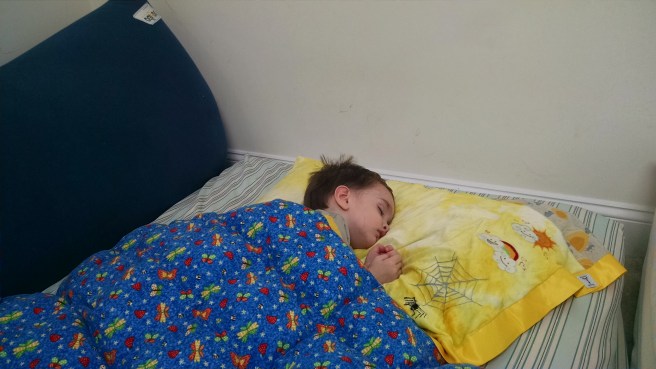
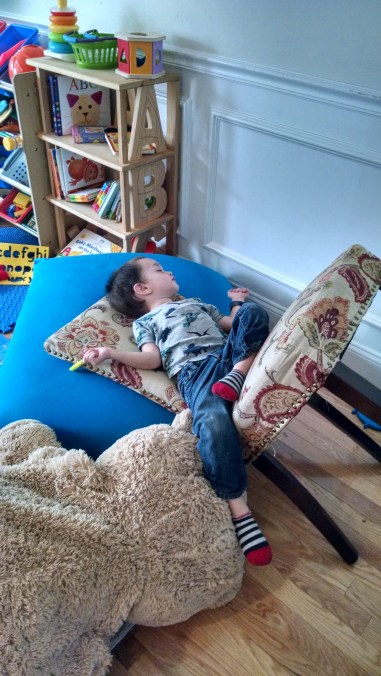
Note: When you have a kid that doesn’t sleep, sleep is something to document. So we have a bunch of sleep pictures of R. This post will contain some of my favorites. Enjoy. 🙂
It’s 3am. R is giggling and bouncing on his knees on the bed. He pauses, throws his head back, gazes open mouthed upwards to something my eyes don’t discern, then laughs and resumes bouncing on his knees. He has been awake since 11:30pm, after having slept just three and a half hours. He will stay awake the rest of the night, and is still awake at the time of my writing this, 9am the next morning. This despite taking enough prescription sleeping medication to “knock out a typically developing three year old for two days straight,” as R’s rather humorous but blunt sleep specialist put it.
When we first began to see sleep difficulty with R, his Developmental Pediatrician at the autism clinic where he is followed told us that Autistic brains appear to simply not require as much sleep as neurotypical ones. But even given that reduced requirement, around his 2nd birthday, R began sleeping drastically less than is safe or healthy for a young child.
It started innocently enough. A bedtime that crept gradually later and later, lulling us with a sense of normalcy. Until one day it occurred to me that he was going to bed no earlier than midnight, and that we didn’t know any other children that slept that late and had already dropped their naps as he had! Then came the night waking. He would wake in the middle of the night full of energy as if it were morning. He would play for a while, and eventually fall back asleep. When we first began to have concerns about his sleep, he was getting a total of about 9 broken hours per night. At his age at the time, it was recommended that children sleep at least 12 hours. We shared our concerns with his DP, who gave us the tidbit about Autistic brains, and advised trying Melatonin, an over-the-counter sleep aid that helps with falling asleep, but she was not overly concerned. From where I sit now, I can see why. I would LOVE to see R get 9 hours a night at this point.
We did begin Melatonin, which helped with the length of time it took him to fall asleep, but it didn’t help him stay asleep. As time passed, his sleep grew progressively worse. He was sleeping from midnight to 2am, then staying awake from 2-6am, then sleeping 6-8am. He was getting a total of 4-5 broken hours of sleep, and still not napping during the day. He was two, and supposed to be getting 11-14 hours of sleep per 24 hour period. After a few months of this his DP agreed that he needed medication for sleep. We were referred to a sleep specialist and R was started on Clonidine, a blood pressure medication used off label to treat ADHD and sleep disorders in children.
At first, Clonidine was amazing. He was sleeping about 9 hours per night while on it, about double what he would get off of it. We also found that it reduced some of his compulsive sensory seeking. Prior to Clonidine, R had a compulsive need to run constantly. He would run circuits around our block, over and over, throughout the day. One day we decided to calculate his mileage, and discovered that at 2 years old, he was running more than 2 miles every day! After starting Clonidine this reduced dramatically, down to 1/4 mile or less per day. Yet his mood and energy level remained high. He was not tired or slowed down, he just didn’t need to compulsively run anymore.
About a month after starting Clonidine, his sleep began to decline again. The doctor upped his dose. Two months later it began to decline again, and his dose was increased again. This would go on to happen 3 more times over the next year. Now at age 3, his dose is about 8x higher than it was when we started Clonidine (he was started on 1/4 of a tablet, and now takes 1.5 to 2 tablets per night). During his most recent sleep regression, about 2 months ago, the doctor not only increased his Clonidine dosage to what he takes now, but also added a prescription for Trazodone. With his Melatonin, Clonidine, and Trazodone, we were administering 5 pills total each night…to a 3 year old. Have you ever tried getting a 3 year old to take PILLS, not liquid medicine, but actual pills? Now imagine that he has special needs, cannot understand what is said to him, and due to his feeding disorder cannot tolerate any of the things usually used to disguise medication for children (applesauce, chocolate pudding, chocolate milk, juice, etc). It is no easy task..
Trazodone did not go well for R. We would find that it worked great for about 3 days, and then seemed to accumulate in his system to where by day 4 we were starting to see moodiness and exhaustion during the day, like a hangover. Days 5 and 6 would be absolutely miserable. By day 7 my husband and I would both agree we just couldn’t give it to him that night. So then he wouldn’t sleep well because he wasn’t getting the additional medication, but at least he was happy. For a while we tried cycling the Trazodone- 3 days on, 3 days off. But that had inconsistent results. We finally decided it wasn’t worth whatever extra sleep he was getting and stopped giving it to him. Sleep isn’t perfect right now, he has his all-nighters like last night, but he also has several good nights per week, and for now this is what’s working best for him.
Ahh sleep.. Beautiful, elusive, sleep. One day we will catch you. 🙂
It’s been two months- TWO MONTHS! Since R started school. I’ve written a lot about our efforts to transition R to school prior to his start date due to his severe anxiety- a process we spent 5 months on- and which was wildly successful. You can read about it here, and about his resulting fabulous first week of school here. I was hesitant after that amazing first week to write more about how great school was going, in fear of somehow jinxing it. But the past two months have sped by and there is so much to share. R has learned more skills in the past 2 months at school than he learned in the previous 18 months of full time in-home therapies (ABA, ST, OT, DT). Here are a few of the highlights:
R is understanding and able to use a first-then board
R is continuing to learn to use PECS
R learned how to turn a container over to dump the contents
After initial help with hand placement, R is able to hold a bingo dobber (kind of like a chubby marker) and can independently make about 3 dots with it
R learned to jump with two feet (!!!!!!)
R learned how to clap his hands (!!!), and can *sometimes* respond to the receptive direction “clap hands” (the data says 8%, I’m just excited that he understands the language!)
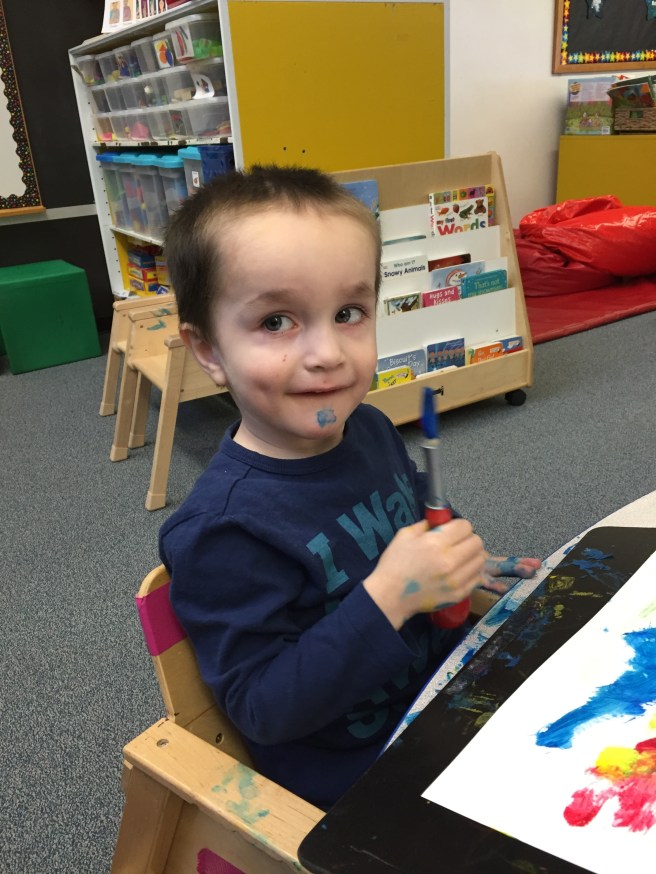
R tolerated exploring paints, holding the brush, and making some paint marks with hand-over-hand support! A BIG DEAL because he has been terrified of paint/art stuff prior to this
And just this week, R scribbled with a crayon for a moment all by himself for the first time!
R exploring paints at school
I feel like R is truly in the best possible environment at school and that is why he is thriving. He is supported by such an incredible team of dedicated, caring, skilled individuals. I think what truly makes it so successful is that the team all work together. There is so much carry-over. His ST, OT, sped teacher, and aides are always sharing information, ideas, and tips, often observing each other working with R, and so it’s just a really well rounded team approach to each challenge R is working on. We are currently in the process of finding out if R needs PT added on. His teacher and OT have both shared some concerns with the school PT, and I sent a request to evaluate for PT along with some of my own concerns. I love knowing that everyone at school wants what is best for R, not what is cheapest for the budget. The other thing that I really appreciate is seeing how much they all care about R. It is written all over their faces that they adore him. I would have expected kindness and professionalism, but it is clear that beyond that his teacher and aides truly seem to love him, and R seems to love them too. He is almost always very excited to arrive at school, and is often reluctant to leave.
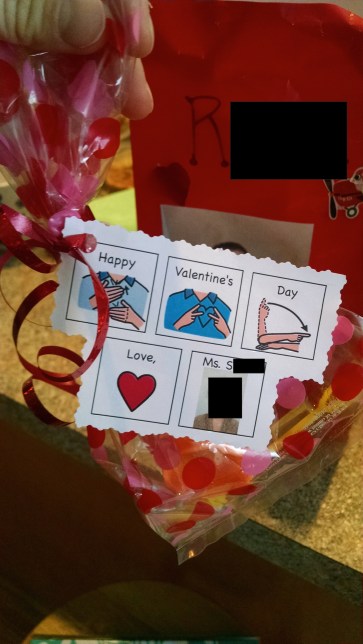
R’s Valentines baggy from schoolValentine from R’s teacher to him
Seeing how much he has flourished in just 2 months, I can’t wait to update at 6 months or a year! Here’s to hoping for many more great things to come. ❤
My son’s school’s PTO is sponsoring a workshop to promote acceptance, understanding, and awareness of disabilities. All of the kindergartners and first graders will attend the workshop. The flyer home requested that volunteers are still needed to staff the various learning centers they will be setting up in the auditorium for the two days that they will be running the workshop. I was immediately interested in volunteering, and emailed the organizer, requesting that I be assigned to the station for Autism and/or Developmental Disabilities if possible. It never once crossed my mind that such a station would not exist. But I shortly received an email response thanking me for volunteering, but letting me know that the workshop only has stations for vision, hearing, and physical disabilities. Apparently this program has been in place for years now, and no one has ever thought to represent Autism and other Developmental, Neurological, and Learning disabilities. Until me. Now. I replied, in part, with the following:
“…I find it very disappointing that Autism and other developmental disabilities are not already a part of this program. Autism affects 1 in 68, and with the momentum of IDEA pushing for supports that allow our children to be included in the general education environment to as great an extent as possible, children like mine now rub shoulders with children like yours in every classroom in America. I find it deeply hurtful that at a time when education, understanding, and acceptance is most needed, an established program to promote these very same principles for children with disabilities would choose to exclude such a large population of disabled children whose at times “invisible” disability makes them incredibly vulnerable to bullying and isolation.
Who can I contact to ensure that in future years children like mine will be represented in these workshops? I would be happy to volunteer my time and energy to help facilitate this.”
In reply the organizer recommended that I put forth a proposal to the PTO at their next board meeting and said they would look forward to my involvement in including Autism and related disabilities in future years’ workshops.
While I’m glad that I have a chance to make a change here, I still have a hard time accepting that no one has spoken up before now about this. I would also imagine that the PTO did not consult with the SEPAC (Special Education Parent Advisory Committee) when beginning this program because I can’t imagine that the SEPAC would have let this slide given that more than half the parents on it have Autistic children!
It’s 2016. Our children are no longer secreted away, segregated outside of mainstream society. Our children are everywhere. They are in your classrooms, they are in line behind you at the supermarket, they live a few doors down from you, they flap and squeal at the playground, you see them jumping and spinning at the park. Our children are right here, and more than ever they need the understanding, acceptance, and support of their communities. I will not let the PTO forget my son next year. I plan to make some noise, insist that the SEPAC be included in the planning of this event, and hopefully, facilitate a change. One little lower elementary school at a time, right?
Recently we have been having some pretty exciting success with PECS! PECS stands for Picture Exchange Communication System, and it is a picture-based alternative form of communication.
Therapists have been trying to introduce PECS to R ever since he was first diagnosed at 18 months. They start very simple- introducing just one picture card of a highly preferred item. Back when they first started trying PECS with R, the card was a screenshot of his favorite Baby Einstein video. Therapist A would play the video for a few minutes then pause it. When R fussed for more, therapist B, standing quietly behind him, would take his hand and hand-over-hand have him pull the video card off a velcro strip and hand it to therapist A. Therapist A would announce “video!” and press play. The idea was that he would eventually make the connection that his video was played every time he grabbed the video card, and then he would begin grabbing it spontaneously without help or prompting from therapist B.
When we initially tried PECS, this never happened. A few months later when we tried again and he did progress to grabbing the card himself, but was unable to discriminate between cards, despite the exact-photo images on them. Meaning that as long as there was only one card on the strip he could and would pull it off. But as soon as you added a second card option, for example “apple,” he would grab one or both cards indiscriminately. The idea was to teach him to choose the right one- so if he grabs “apple,” he is given an apple, and if he grabs “video,” his video is played for him. However, despite exhaustive attempts we were not able to get him to discriminate between cards, and he soon began refusing to do anything more than grab and mouth the cards. So we put them away again. PECS were tried once or twice more and with the same result. About 6 months ago I asked his therapists to put them away semi-permanently and focus on ASL signs. While we did see some receptive language success with ASL, R was not able to form signs expressively.
A few weeks ago I noticed that R had learned what “no” means and was showing consistent understanding of the word. That same week he made faces to himself in the mirror for the first time- a cognitive milestone that typically developing children achieve around 6 months of age, but which R had been missing. Previously he did not appear to realize that the face in the mirror was his own. We had seen one or two other cognitive developments recently, and it occurred to me that with these developments maybe it would be a good time to try PECS again.
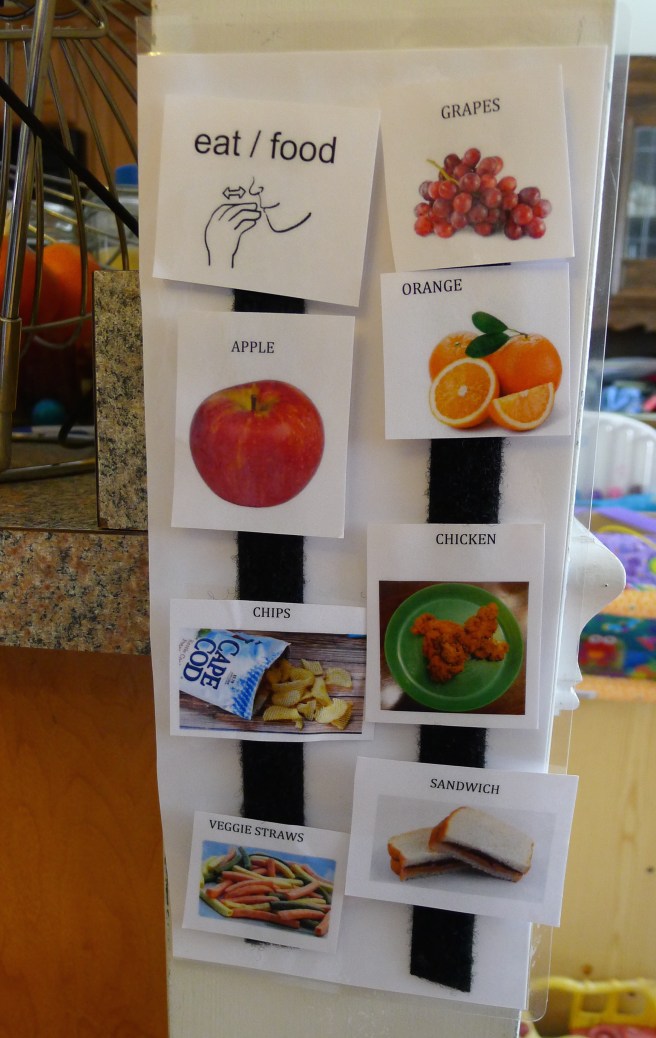
R’s current food strip.
We started with food items, since that is such a concrete thing, easy to make exact photo images of, and something which he interacts with multiple times per day. Every time I brought him something to eat I showed him the card picture of the item. He only eats the same 3-5 food items, so I kept those 4 or 5 picture cards hanging on a velcro strip next to the kitchen when the cards were not being used. I noticed him looking at them on the wall throughout the week, and looking at them when I presented them with his food. After one week of this, R independently went to the strip on the wall and pulled off the “cookie” card to request a cookie spontaneously for the first time! Over the course of the next week he also spontaneously requested “chicken” and “chips” several times. He was really doing it! Watch R request a cookie here.
In our initial excitement over the communication we did allow R to choose “cookie” about 15x per day. But after a few days it became evident we were going to have to deny him or “cookie” was all he was going to ask for and eat. At first I tried removing the “cookie” card from his strip at times when it was not going to be an option. This didn’t quite sit right with me- you wouldn’t remove words from a child’s spoken vocabulary just because the answer is going to be “no”- but I didn’t know what else to do. This did not help or work however, as R simply searched for the card and then had a tantrum that he couldn’t find it. It broke my heart because he was working so hard to communicate with us and didn’t understand why he was being ignored/denied.
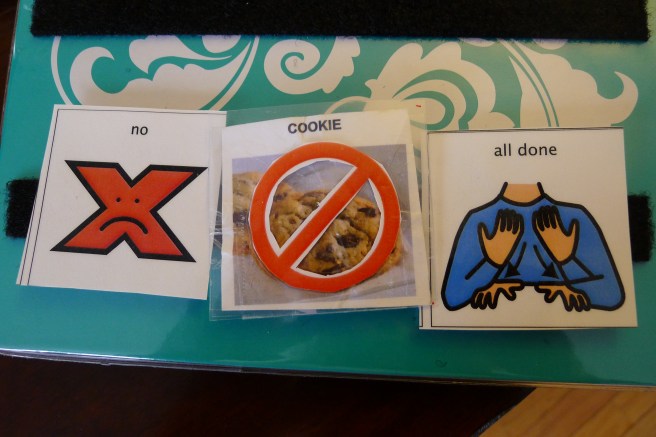
At a loss of what to do, I reached out to an AAC (alternative augmentative communication) group on Facebook that is home to a number of helpful SLPs. They all had the same advice- create a “no” symbol that can be imposed over the card so that R can still see the cookie card, but sees the “no” symbol on top, denoting that it is not a choice right now. I made a clear pocket with the “no” symbol on it, and placed the cookie card in the pocket.
The “no” pocket.
To further help him understand, I also paired it with the “no” and “all done” cards that his school uses in the classroom, and with which his teacher said he is slowly growing familiar. At first he was resistant. He tried to grab the card despite the “no” sign, but I would run his finger over the “no” sign and show him the “no,” “all done” cards and use the ASL sign for “all done” (which he understands) as well.
His next move was to remove the cookie card from the “no” pocket. My husband greatly appreciated this! If the pocket made the cookies off limits, surely just removing it from there would make them available again! We responded by intervening and putting the card back in the “no” pocket and reminding him again that it was “no” and “all done.” At this point I decided to move “cookie” off the wall strip, and onto a separate sentence strip paired with “no” and “all done.”
The sentence strip showing “no cookie, all done.”
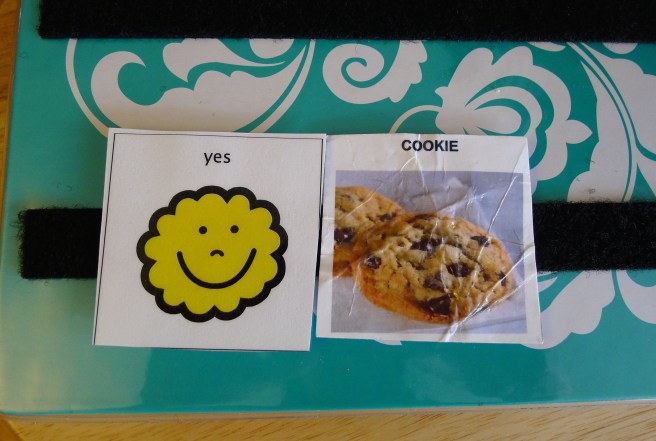
Then when it was time that he was allowed to choose “cookie,” I brought him over and had him watch as I removed “no” and “all done” and took “cookie” out of the “no” pocket. I placed the “yes” card down next to the “cookie” card and kept them on the same separate sentence strip.
The sentence strip showing “yes cookie!”
This arrangement seemed to make more sense to him. He began checking the strip to see if it said “yes” or “no/all done,” and his attempts to remove the cookie from the “no” pocket reduced dramatically.
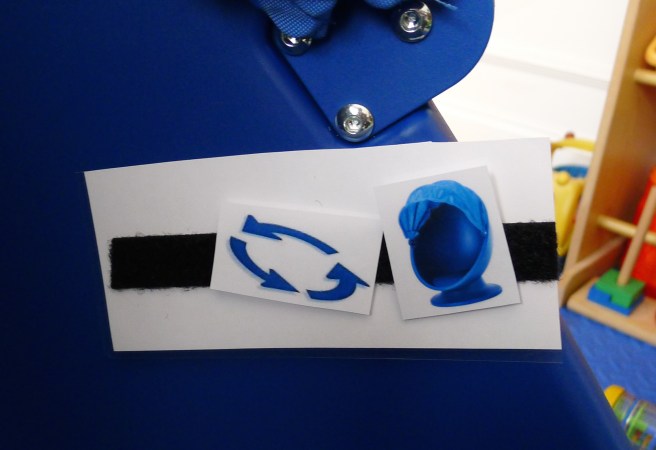
As of this morning we are introducing cards for a few non-food items. For example the strip below is mounted on his spinning chair so he can request to be spun by me or his dad.
I’m really proud of him and excited that we are slowly getting some communication! Hopefully we will have more PECS progress to share in a few weeks or months as we continue to work on this.
R, at school on his first day. This and all following pictures were taken by his teacher/aides throughout his first day.
R had his first official week of school this week. I don’t want to say too much. I’m afraid to expound on how well things went, for fear that fate will give him a terrible week next week to make me eat my words. So I won’t be saying too much. I will share a few things.
R, in his classroom on his first day.
I’m not sure if I’ve written much about R’s placement. He is full-day in a substantially separate classroom, meaning that he is in a separate special-education classroom, not an integrated (mix of sped and gened) room. His classroom houses children with severe disabilities ages pre-k through 1st grade. There are 7 other students. He has a 1:1 aide with him all day, and receives twice-weekly direct speech and OT. All of the staff that work with him are wonderful. We have really had the opportunity to get to know them all over the last 3 months while they worked with us daily on R’s transition- something I’ve written about here.
R, in his classroom on his first day.
The Friday before R’s first week he stayed in his classroom for 2 hours and did not want to leave. We knew he was ready. When his first day arrived, the reality that he would be there for a whole 6 hours without me really started to sink in as I got him ready that morning. I dropped him off, me a bundle of nerves, and he went right into his wagon (his teacher and aide had begun taking him to the classroom in a wagon after we discovered how much he loved that). He was calm and happy and did not spare me a glance as he rode away. I was happy for him, so happy to see him perfectly comfortable at school with his staff. But I still left holding back tears. It’s hard to walk away from your baby for the first time, and R will always be my baby.
R, in his classroom on his first day.
When I arrived to pick him up he came out all bubbly and smiley. They said he had a wonderful day and was happy all day. When I got home I had an email from his teacher with pictures from his first day. He looked so sweet and joyful!
R, on his first day.
The rest of the week continued to go well, with the exception of a cold he developed. Still, despite the cold he continued to have good days at school and came home to us incredibly happy. Both my husband and I could not stop remarking on what a great mood he was in from the time he got home until bedtime. As if his time away had made home all the more interesting and exciting, he has been incredibly joyful and content each afternoon and evening.
R, on his first day.
Perhaps the best thing has been the happy dance he does every time he spots me when his aide and teacher bring him out to me. He starts off walking the way he always does- unsteady and distracted- stopping to try and lick a wall or a puddle, or rub his fingers over bricks. They get closer and closer to me until I can’t wait and I close the gap and call to him. As soon as he sees me his entire face breaks out in the biggest grin. It stretches ear to ear, his eyes spark with pleasure, and he begins tap-dance-like involuntary body movements of excitement. Some autistic kids flap or jump when excited. My son does something in between. He bounces on his feet, not quite a jump but almost, tapping and dancing his feet around, lifting his arms in joyful little tremors. I scoop him up and we hold each other so tight. He squeezes and presses his cheek to mine, he giggles his delight outloud. He babbles happily. I can’t stop smiling. Leaving him every morning is worth it just for that reception every afternoon.
“I’m just so tired of making him cry,” I croaked to my husband on the phone, tears streaming down my face. I had just gotten home from what was to be our last feeding therapy session at the OT center R attended twice a week.
“If they don’t know how to treat him with respect, if they can’t see how amazing he is, we don’t need them. They don’t get to treat him like that. No way. I don’t want him back there, never.” My husband tells me intensely, trying and not quite succeeding to keep his voice down at work.
“I don’t know what to do,” I whisper, “we waited 6 months to get in there, and he NEEDS the help, we can’t let him starve. I don’t know what to do, but I agree with you, I can’t take him back there. I can’t let her do that to him again.”
“We’ll figure something out,” my husband says soothingly, “it will be okay.”
It was the last week of November. R had started feeding therapy at this center, we’ll call it Center A, in September. R eats only 3 foods, none of which are particularly healthy, and has a great deal of anxiety, rigidity, and sensory issues surrounding food. He is also unable to use utensils. Sometimes he goes through periods of total food rejection, and fasts for days, or sometimes weeks (relying on breastmilk and pediasure instead). We were first referred for a feeding evaluation at the hospital in March. We would not get a spot at Center A, an OT center near us that does feeding, until 6 months later due to the long wait list. There is only one other out-of-hospital center (which I will refer to as Center B) that offers feeding therapy in our area, and it is twice as far from our home as Center A.
I’ve written before about R’s anxiety. It is pretty extreme. He cannot go to new or unfamiliar places without screaming and crying the entire time. If we want a new place to become an accepted “safe” place for him, we have to practice going multiple times per week for several weeks. At Center A, it took 5 weeks of going twice weekly before he was able to be there without melting down the entire time. His feeding therapist, an occupational therapist specializing in feeding, seemed taken aback by his extreme reaction to the center. The center has lots of toys, a fun gross motor gym with the kind of equipment R, and most kids, love– ball and foam pits, trampoline, enormous exercise balls, platform swings, spinning swings, a sliding board, and more. I tried again and again to explain to her that she needed to be patient, that if we give R time and space he will adjust and go from screaming the entire time to laughing and engaging with joy. She did not want to be patient. She wanted to treat his anxiety like bad behavior, and be firm and insist that he engage in the therapy session. I felt like working on his transition should be the first goal, not diving right into the feeding goals. She complained on week three that we were not doing any feeding, and he needs to be there for feeding. He was making slow progress adjusting to the center, and it frustrated me that she didn’t see how valuable that was, how far we had come. She continued to try and place demands, and made passive aggressive remarks about the things I would not back down on (“Are you going to breastfeed him until he’s in college?” when I insisted on allowing him to breastfeed to soothe himself). She also made comments about him personally which I found offensive, such as “I don’t know why kids like him have to get so fixated,” and “It always seems like there’s nothing going on upstairs with these kids, but sometimes they prove you wrong!” At a brushing seminar she asked us to attend, she told the class that Sensory Processing Disorder (which is part of R’s Autism) is like a moldy pie, and you need to scoop out the mold. Comparing our children to moldy pies? That was the best analogy she could come up with? No thank you. Still, we kept going. Our options were so limited, and she did have some valuable ideas for implementing at home, with which we saw some small progress. In person however, it was a nightmare. I began to feel that we were just going there to make my poor child cry. After 5 weeks he had conquered his anxiety to the center. He walked in happily and went straight for the toys. He loved the gross motor gym, and would happily swing and run around. But his therapist was not satisfied. She wanted him to work on feeding, and wanted it to happen only in the feeding room (a room that still scared him), and she wanted him to engage in the activities she had prepared for him. Those activities were inappropriate for his cognitive ability level, and coupled with his low receptive language, it was impossible for him to participate. For example one day she wanted him to build a snowman with mashed potatoes, and use raisins for eyes, baby carrots for arms etc. He doesn’t know what a snowman is. He doesn’t understand or engage in symbolic/pretend play. The entire exercise was completely over his head. Add to that his anxiety around the new food items and textures– the very anxiety such an activity was intended to mitigate in a more-abled child– and R was completely overwhelmed. He would just cry and try to leave. The therapist continued to grow frustrated with R. It seemed she viewed him as “noncompliant,” refusing to acknowledge the very real and valid fear and anxiety and sensory overload that he was experiencing in her care. Despite all the time that had passed, she had also still not formed a connection with R, something that usually happens very early on with his therapists. Each week we took him, on Tuesdays and Fridays, and I watched him go from happy and smiling in the gym, to crying, afraid, and overwhelmed in the feeding room. Then he would be released for another break in the gym, recover his composure, only to be brought back into the feeding room and have it all torn away again. Four and five times per session he was taken back to the feeding room and made to cry. She had begun forcing him to touch the foods, by quickly tapping a food to his mouth, or by using hand-over-hand to have him briefly hold a food item, such as a potato or carrot. This was always stressful and upsetting for him. It began to feel so cruel to me. I struggled with trying to decide if this was for his own good– with his severe ASD and GDD was this the only way it could be done? In my gut it felt wrong. I kept telling myself, we’ll give it one more week. If it doesn’t improve, or if she treats him more harshly we will stop. Some afternoons I was so sure we would quit that day and not go back. But then later I would cool down and second guess myself. Maybe I’m being too emotional as the mom. Maybe I need to give it more time. Perhaps we should give it 3 months before making a decision.
On the day that we quit, his feeding therapist asked me not to be in the room. She said I was a distraction, that he clung to me, and that the reason she wasn’t making a connection with him was because I was always between them. I have always been present in the first months of therapy with new therapists, and I have never before seen my presence inhibit the forming of a bond between the therapist and my son. However, that was always at home, not at a center, so I decided to give her a chance. I knew I could watch through the two-way mirror in the parent observation room.
I then watched through the window as she instructed his ABA therapist, who remained in the room to assist, to hold him in his chair so that he could not get up and move away. She then brought out cream cheese and food coloring and wanted him to finger paint. I had already informed her in the past that R does not understand art play- he does not scribble with crayons, he is not interested in paints or playdough. EI group used to try and make him participate in their art activity. One day they stuck his hand in the glue and he burst into hysterical tears. We soon learned that he finds soft/wet/messy textures aversive. After that he would cry at the sight of paint, glue, and even play dough. This was all information I had already given the feeding therapist- indeed, a major part of his feeding therapy goals was to work on making wet/puree textures less upsetting for him so he could eventually eat them. I suppose the therapist thought finger painting with cream cheese was a good way to explore that texture in a fun way so it wasn’t scary. For another child it may well have been. I thought by now she understood that for him it certainly wasn’t. He didn’t understand it, so it was not fun, it was terrifying. He refused to touch the cream cheese and kept trying to scramble out of his chair, but was held in place by his other therapist. I watched the feeding therapist grab his hand hard and pull it to her, as he struggled to pull away and cried louder and louder. She then smeared cream cheese all over his hand while he screamed in pain and terror (remember, an aversive texture feels physically painful to children who process it that way). He was screaming and sobbing and was unable to get free. She then forced his hand to his mouth and shoved it at his mouth to make him taste it. In the observation room I stood watching stunned, horrified, and filled with growing rage. She then wiped his hand off, and I thought she was done, but instead of letting go of his hand she proceeded to repeat the entire process, while he still sat sobbing helplessly. At that point I went in there and grabbed him and told her we had to go. I was so upset I couldn’t even confront her, I just wanted to escape. Later I would feel like a coward for this. I cried the whole way home and called my husband. We agreed he would never go back there. We agreed that we should have called it off long before it got to this point. I will always regret that we didn’t quit as soon as it began to feel wrong. Now I know better. Now I will do better. Later our ABA therapist would admit to me that she was glad we quit, that it was making her uncomfortable too. She is not allowed to comment on clients’ choices in private therapy and she felt awkward, being unable to speak her mind on the matter. I think it is interesting that we had an OT doing all the things ABA is denigrated for, things our ABA team have never done, and our ABA therapist herself was upset by it.
Center B
It has been a month since we quit feeding therapy at Center A. Wary of trying another center, I avoided looking into Center B. I spent the month seeking a feeding therapist that would be willing to come to the house and work with us privately in our home. I contacted several possible therapists, but none were willing or able to work in our home. Meanwhile R dropped all but one of his foods, potato chips, and went a week eating only chips. I knew we needed to get help, so I reluctantly called Center B. On the phone I was in battle mode. I stated firmly that I was unwilling to set up an evaluation until I had been given an appointment to speak personally by phone or in office with the clinical director. I informed the secretary that we had a very high needs child and I didn’t want to invest time and energy into a placement until I had confirmation from the director that his needs could be accommodated there. I was ready to argue, but the secretary calmly said, “Well we always do a one-hour intake by phone with the clinical director before scheduling the assessment. If you’re willing to let me take down some information then we can go ahead and schedule that.” Taken aback that this was already part of their routine, I agreed. The following week the clinical director called me at our scheduled time. We spent over an hour discussing what went wrong at Center A, what kind of accomodations R needs, the necessity of experienced therapists that can work with a severely impacted child, and the specifics of what I’d like to see for R’s therapy goals. Throughout the discussion the director explained how they would approach situations, and each time it was exactly how I would have requested that they approach it if I had been asked. This was really encouraging, and I was cautiously optimistic. I completed all their paperwork, and his assessment was scheduled for January 19th.
When we arrived at Center B, R was crying hard, which is normal for him when we go somewhere new/unfamiliar. Me and his ABA therapist took turns trying to soothe him as we waited, showing him videos he likes on the iPad, hugging and squeezing him, verbally empathizing. After a few minutes the clinical director and the therapist she hoped to pair with R came out to get us. They first had us bring R to wash his hands at the sink, and then we went into one of their gyms. R was still crying and anxious. We and he noticed immediately however, that they had the exact same spinning chair R uses at home and at the sensory gym to calm himself and play in. This was like divine intervention! He went straight into the spinning chair, still crying, and the Center B therapists followed him over and began to spin him.
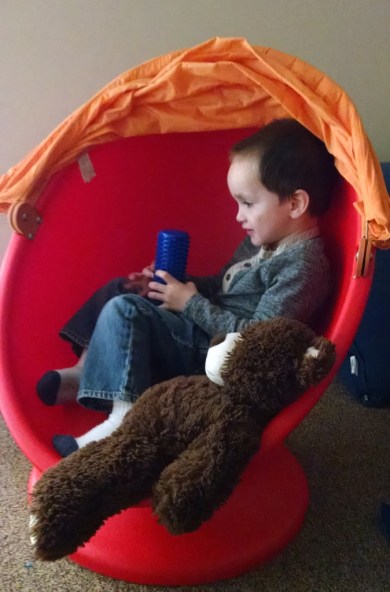
The spinning egg chair R uses to calm himself. This picture was taken at the sensory gym, but Center B had the exact same chair, orange color and all. Ours at home is blue.
They did not speak to him or us, and it was clear by their demeanor that they wanted us to remain silent. Me and the ABA therapist sat back, a few feet away. We all sat in silence as they spun him. They did not try to make eye contact with him, they were very quiet and still. He began to calm himself. His tears dissipated, and a few minutes later he took some deep breaths. He seemed ok, though highly sensitive, teetering on an edge. One of the therapists began quietly blowing bubbles for him. The second therapist would pause in spinning him while the bubbles were blown, then after a moment spin him some more, then pause and more bubbles. At first he ignored them, but as he felt more and more calm he began to watch the bubbles, then finally he reached for one. After a few more minutes of bubbles the therapist put them away and took out a sensory ball (a ball with bumps/blunt spikes all over it). She began massaging his foot with the sensory ball. I don’t know how she knew that he might like this, but this is one of his favorite activities at home. He loves any kind of foot massage and really enjoys the texture of sensory balls. At this point I began crying a little because I was just so happy and amazed. Since his anxiety started this has NEVER happened. We have never been somewhere new that he was able to calm down at on the first visit. I was absolutely floored. I sat there trying desperately not to lose it and all out sob! This was about 15 minutes into the session. The therapists, gauging his growing comfort level, spoke for the first time. They began talking to him softly and gently at first. One of them quietly read to him from a board book while the other spun him and massaged his feet. After a few minutes of this he spontaneously decided to jump out and go for the swing, which he had been eyeing quite a bit since achieving a calm state. He climbed onto the platform swing and laid down on it, waiting to be pushed. The therapist pushed him on the swing quietly first, and then more playfully, counting down to big pushes, and pausing mid push to pull the swing up close and playfully exclaim “I got you!” R cracked a huge smile and was officially 100% “himself”- the happy, joyful, playful R that we see every day at home. The rest of the assessment went great. I left ecstatic. This is where he belongs. These people get it. They were perfect, they were brilliant. Later, discussing it with my husband, we both recalled how whenever R is somewhere where he is experiencing his anxiety, he is trying SO HARD to calm himself and hold onto his control. Once the fear and anxiety reaches a certain point of no return it becomes a meltdown, and is totally out of his control. We see him struggling to keep that control, to calm himself down. And it is such an effort that even a single spoken word- not even spoken to him- even just me saying something to another adult in the room- is enough to cause him to loose it. Have you ever needed absolute focus to do something? It’s like trying to remember a number and then have someone yelling random numbers in your ear. It’s impossible. I think that’s what happens to him when he is trying to calm himself- something as simple as a spoken word or an unpredictable movement in his vicinity (like someone walking into the room) can negate all his efforts. Somehow the therapists at Center B understood this, even though it wasn’t something I had completely understood myself until after watching them with him. Like some kind of mythical autism whisperers, they knew just what to do, even better than I could have. They get it, they respect it, and I think me and my husband can learn as much from them as R can learn through the therapy. I can’t wait to see where this goes.
It’s Sunday. It’s officially the first day of our last week in Early Intervention. One week from today my son turns 3. At 3, the school district takes over his services, and Early Intervention (birth to 3) is finished. I’ve written about our work transitioning to the school district. We have had his IEP ready to go since November. None of this has snuck up on us. But somehow, it feels so very sudden.
It’s hard to believe that next week I won’t have people in my home for 5 hours a day anymore. We won’t have the revolving door of no less than 8 therapists coming and going weekly. The day-to-day realities of the last year-and-a-half are ending. We are embarking on something new. 18 months ago I had to trust a group of strangers. I had to trust them enough to let them in my home for most of the day, 5-days a week. I had to learn to let some things go, to delegate, to allow for a different trajectory than I had envisioned. Now I need to trust again. Now I will trust another group of strangers. This time, I won’t be there to oversee every moment.
I’m excited and terrified. I’m hopeful and apprehensive. I’ve met R’s teacher, his new therapists at the school. They seem wonderful. The logical part of my brain is overjoyed and eager, feeling certain that my little boy will be in good hands. The emotional part of my brain can’t stop asking “But what if…?”
I read a lot of fantasy. Epic fantasy, urban fantasy, YA fantasy, sci-fi, vampires, werewolves, wizards, fae, gargoyles, demons, angels you name it. I still re-read Harry Potter in its entirety almost every year. I spent a decade of my life immersed in Robert Jordan’s Wheel of Time series, starting as a teen, and ending as a mom of 3. I was reading George RR Martin’s Game of Thrones series before it was a thing. Years before. I actually recommended it to a nerdy type friend who I thought would enjoy it in 2005. He forgot my rec, and then 4 or 5 years later when the hype started he tried recommending it to me! Pffft dude. YOU may have discovered this series now that it’s a thing, but I was reading this back when it was fringe enough that when I had a question for the author I emailed him and he emailed me back the same night. You know. Cuz he wasn’t a legend yet and wasn’t receiving thousands of reader comments/questions per day. So yeah, I pride myself on being a serious fantasy reader.
One of my favorite fantasy templates is the Special Snowflake. This is a story about a very special individual, usually unique even among other supernaturals, and often raised apart from the supernatural community, mistakenly believing themself to be a regular human. As this person’s abilities emerge, they must learn to control them and discover their destiny.
What does this have to do with autism? Spidey senses. Whenever I get into a good vampire book I think to myself that in real life vampires would be autistic. Or, SPD at the very least. You know what happens when you have supernaturally heightened senses? The world drives you nuts. Everything is too loud, forcing you to hum or rock back and forth to drown out the noise. You get lost in visual details and lose the bigger picture. The perfume your teacher thinks is barely perceptible makes you gag every time she leans over your chair, not because the scent is unpleasant but because you can smell it too much. Your clothes feel like sandpaper rubbing you raw. It’s all too much. You need strategies to reduce the stimulation so you can cope and function. Some fantasy books are clever enough to realize this and it is part of the story. The protagonist is overwhelmed and can’t control their heightened senses and supernatural abilities. At this point in the story a mentor often emerges. This is another supernatural individual who guides our protagonist through these terrifying changes. They can do this because they know what it feels like.
I’ve been thinking how great it’d be if our autistic kids got to have someone like that in their lives. I chose Yoda for the picture and title because, let’s face it, you probably wouldn’t have known who I was talking about if I used a reference from one of my favorite books. 🙂 But everyone knows Yoda. When Luke Skywalker needed a mentor to train him in the force he found Master Yoda. Our kids need their Yoda. Wouldn’t it be amazing if, when kids were diagnosed, along with all the therapists and specialists they are referred to they were also assigned an autistic adult mentor? Someone with a similar sensory profile. Because my examples were all about hypersensitivities, but there are lots of kids, like my son, who also have some serious hyposensitivities. Kids that are always looking for more input because they can’t feel enough. I would love to have someone in my son’s life who knew first hand what it felt like to be him. Someone who could give us and him ideas for coping strategies, and safe ways to meet his sensory needs. Someone who could help him discover his strengths and the best ways to play to them. How awesome would that be?
*image is a screenshot from the movie The Empire Strikes Back. This image belongs to Lucasfilm Ltd. and its usage here qualifies as fair use under U.S. copyright law
Well, I did it again. Jinxed myself. In my last post I mentioned how normally after we have overnight guests, the day or two after they leave R will have frequent crying bouts and meltdowns as he processes the stress that he had bottled up during their visit. This has never not happened. Until this week, when after we had family visiting for Christmas we went two days post-their-visit without incident. Homefree. Or so I thought. Mere moments after publishing my post this morning, R began getting fussy. Over the next several hours he became increasingly unhappy. Little bouts of crying turned into big bouts of crying, and by 3 pm, full blown meltdowns. The next four hours were awful. I put him to bed early and I can still hear him sniffling in his sleep from the next room over.
If I hadn’t shared my excitement over his lack of bad day after visitors this time, would it have happened? I know logically my choosing to share or not share, feel excitement or not, should have no impact on the future. So why does it always seem to, against all reason?
Going to bed. Tomorrow will be better, God willing.












 Autventures